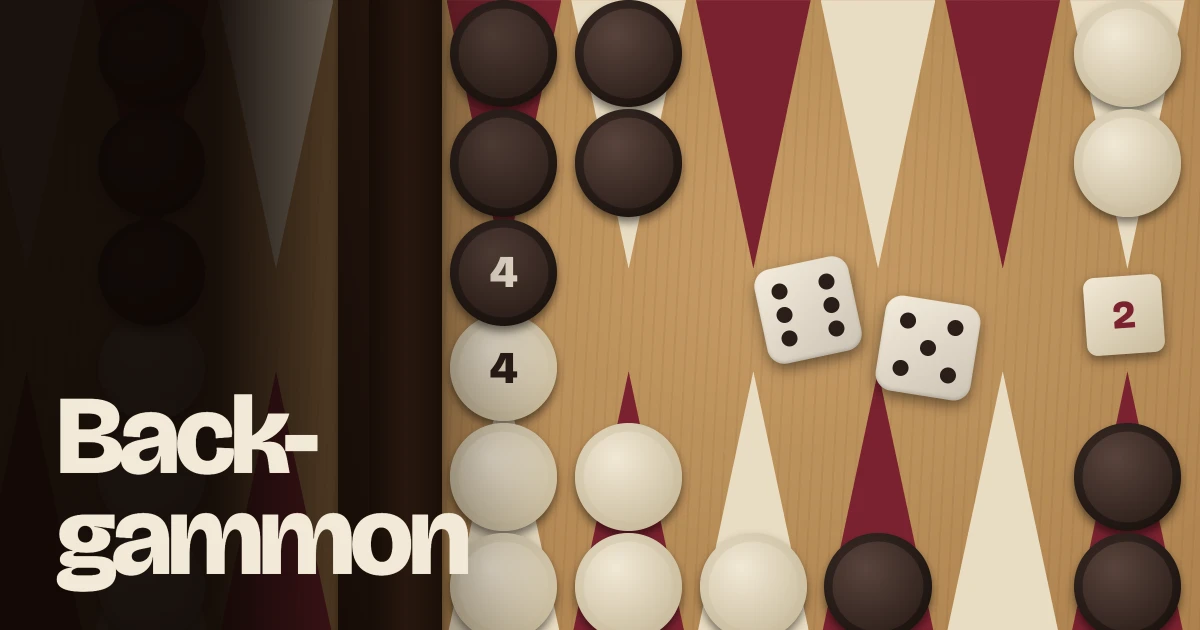
Backgammon
Backgammon is the oldest game we know of that is still played the same way, and the reason is the dice. Fifteen checkers race home against fifteen going the other way, every roll offers a handful of legal moves and only one good one, and a checker left alone can be sent back to the start. Then there is the cube: at any point you can double what the game is worth, and your opponent must take it or concede.
The table is still being built. The rules below are the real ones — the order we build in is set by the vote.
Roll
Two dice, two moves — or four when they match. You must use every number you legally can.
Hit
Land on a lone enemy checker and it goes to the bar, back to the far end of the board to start again.
Bear off
Once all fifteen of your checkers are home, start taking them off. First to clear all fifteen wins the game.
Can I play Backgammon on NowPlay yet?
Not yet. Backgammon is on the workshop bench — the rules and the strategy guide are here now, and the table is still being built. The order we build in is set by the community vote on the shelf, so a vote for Backgammon moves it up.
What happens if you cannot move in Backgammon?
You forfeit the roll and play passes. It comes up most often with a checker on the bar facing a home board where several points are closed — and if all six are closed, you cannot move at all until your opponent is forced to break one.
Do you have to use both dice?
Yes, whenever any legal sequence lets you, even when every one of them damages your position. If only one of the two numbers can be played, you must play the larger one if the choice exists.
What is the doubling cube for?
It lets either player raise what the game is worth. Offer a double and your opponent must concede the current stake or accept and play on for twice as much — and accepting takes the cube, so only they can double next. It turns a race into a series of decisions, and cube errors cost more across a match than checker errors do.
What is a gammon?
Winning while your opponent has not borne off a single checker, which is worth two points instead of one. A backgammon is three, and needs them to also have a checker on the bar or still sitting in your home board. It is why a player who is clearly losing races to get one checker off.
Is Backgammon luck or skill?
The dice decide single games often enough that anyone can win one. Across a match — and especially with the cube, where every position asks a second question — the better player wins far more than they lose. That gap is what a rating measures, and it is why matches here run to five points rather than one.